(来源:《China Daily》 2026-08-31)
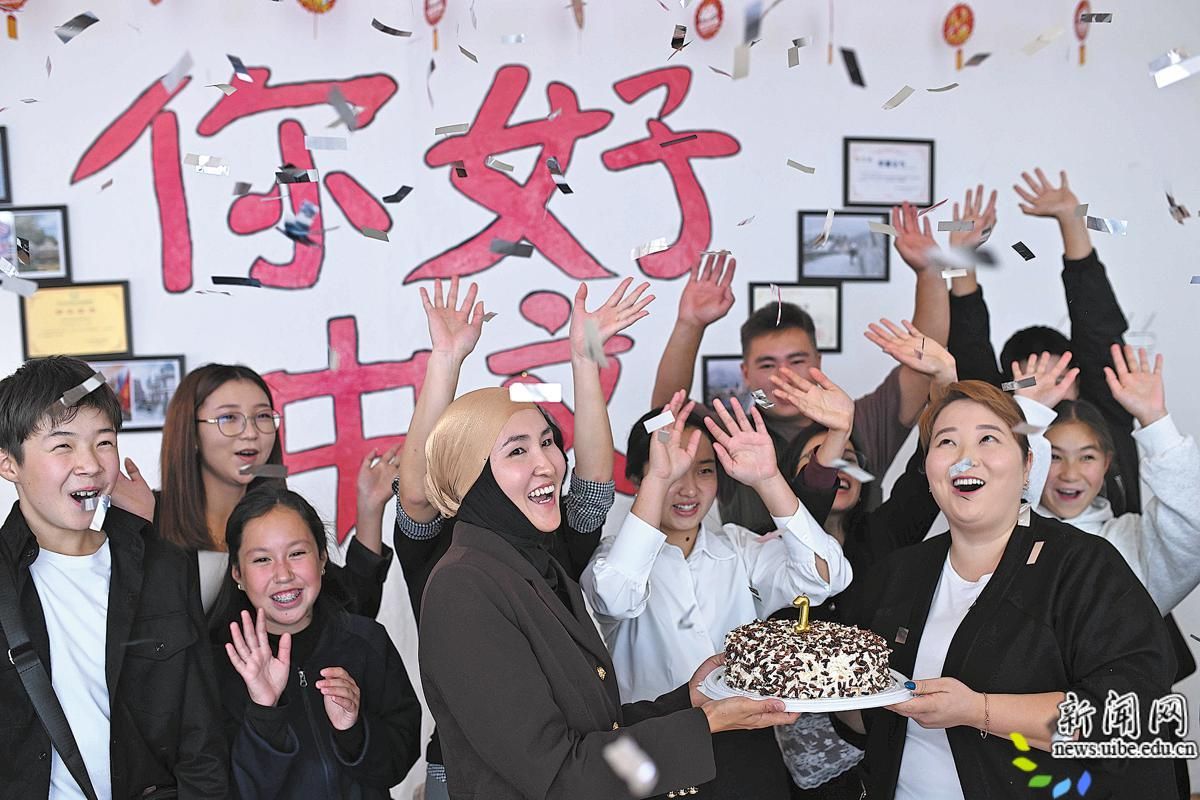 A Chinese-language teacher in Kyrgyzstan (front, right) and her colleagues celebrate the one-year anniversary of the "Hello, Chinese language!" learning center together with students in Karakol, Kyrgyzstan, on Sept 22, 2025. LI RENZI/XINHUA
The number of people appearing for Mandarin proficiency tests in Kyrgyzstan has surged more than threefold over the past five years, reflecting a growing interest in the Chinese language amid deepening economic ties and educational cooperation between the two countries, the administrator of the HSK examination said.
Li Peize, general manager of Chinese Testing International Co, which administers the exam, said the total number of HSK candidates across all levels grew from 3,139 in 2021 to 12,611 in 2025 in Kyrgyzstan.
According to Li, in the first half of the year, more than 7,600 candidates took the test, with the annual total expected to exceed 15,000. The number is projected to surpass 20,000 by 2028, making Kyrgyzstan the first Central Asian country to reach that milestone, he said.
He said that Kyrgyzstan's interest in China shows that the bilateral relationship has entered a golden era. "Economic and trade needs have created a broad market, policy support has built a solid bridge, and the desire to study in China and cultural identification have injected endless vitality," he added.
China has become a major source of investment in Kyrgyzstan. Major projects — from hydropower stations and ski resorts to financial investment zones — have created abundant local job opportunities, Li said. The China-Kyrgyzstan-Uzbekistan Railway and cross-border e-commerce have further fueled demand for professionals with both Chinese-language skills and technical expertise, he added.
The Chinese Embassy in Kyrgyzstan has for years run a scholarship program that requires applicants for full scholarships to have completed at least HSK Level 3. Four Confucius Institutes and more than 20 Confucius classrooms have been established in the Central Asian nation, along with a Luban Workshop and a Silk Road School for cross-border e-commerce — initiatives that link language learning with vocational training and employment, he said.
Li noted that a growing number of young Kyrgyz people also consider Chinese as a gateway to better opportunities. China's world-class educational resources, increasingly convenient visa policies and transportation links have made studying in China more attractive than ever.
The profile of Chinese learners in Kyrgyzstan has also diversified. Test-takers now include university students, civil servants, translators, business professionals and skilled workers — evidence that Chinese is shifting from a cultural interest to a practical tool for career advancement, he added.
For many Kyrgyz students, learning Chinese has opened doors to new experiences and opportunities in China.
Ayana Bazarkulova, 20, a student at Beijing Foreign Studies University, said that she has been interested in Chinese culture since childhood.
After two years in China, she described the country as "highly developed and modern, especially in terms of technology".
"Almost everything can be done online — shopping, ordering food and paying bills, by using digital payment systems. It makes daily life very convenient and efficient," she said.
Bazarkulova added that Chinese people are "friendly, kind and welcoming" toward international students.
Having studied Chinese for nearly three years, she finds the language fascinating. "The Chinese characters are very interesting, each with its own meaning and history. I also like the tones because they make the language different from many others," she said.
Erkemai Zarylbekova, 19, a student at Beijing International Studies University, said that her older sister inspired her to learn Chinese.
After two years of study, she said China is a modern, safe and convenient country to be in with its excellent public transportation and advanced technology.
"Chinese people have always been friendly and helpful to me. Even when my Chinese was not very good, many people were patient and encouraged me," she said.
Nuraiym Aibekova, 27, a second-year PhD student at the University of International Business and Economics in Beijing, first came to China in 2018. She returned to campus in 2023 and said China has become "like a second home". She praised the country's safety, cleanliness and convenience — from online shopping to efficient public transportation.
She passed HSK Level 4 after only four months of intensive study and later obtained levels 5 and 6.
"At first, I learned Chinese because it was necessary for my studies and daily life," she said. "However, as my language skills improved, I realized that Chinese opened many new opportunities for me."
附原文链接:https://enapp.chinadaily.com.cn/a/202608/31/AP6a94bb14e4b08dc8223f31e9.html