(来源:《中国日报》 2026-11-21)
编者按:近日,对外经济贸易大学国际关系学院教授、公共外交与国际传播研究中心主任赵鸿燕接受《中国日报》记者采访,谈APEC围巾的外交礼仪和中国文化意蕴,及其跨文化理解。《中国日报》(APEC专题)报道,主要内容如下:
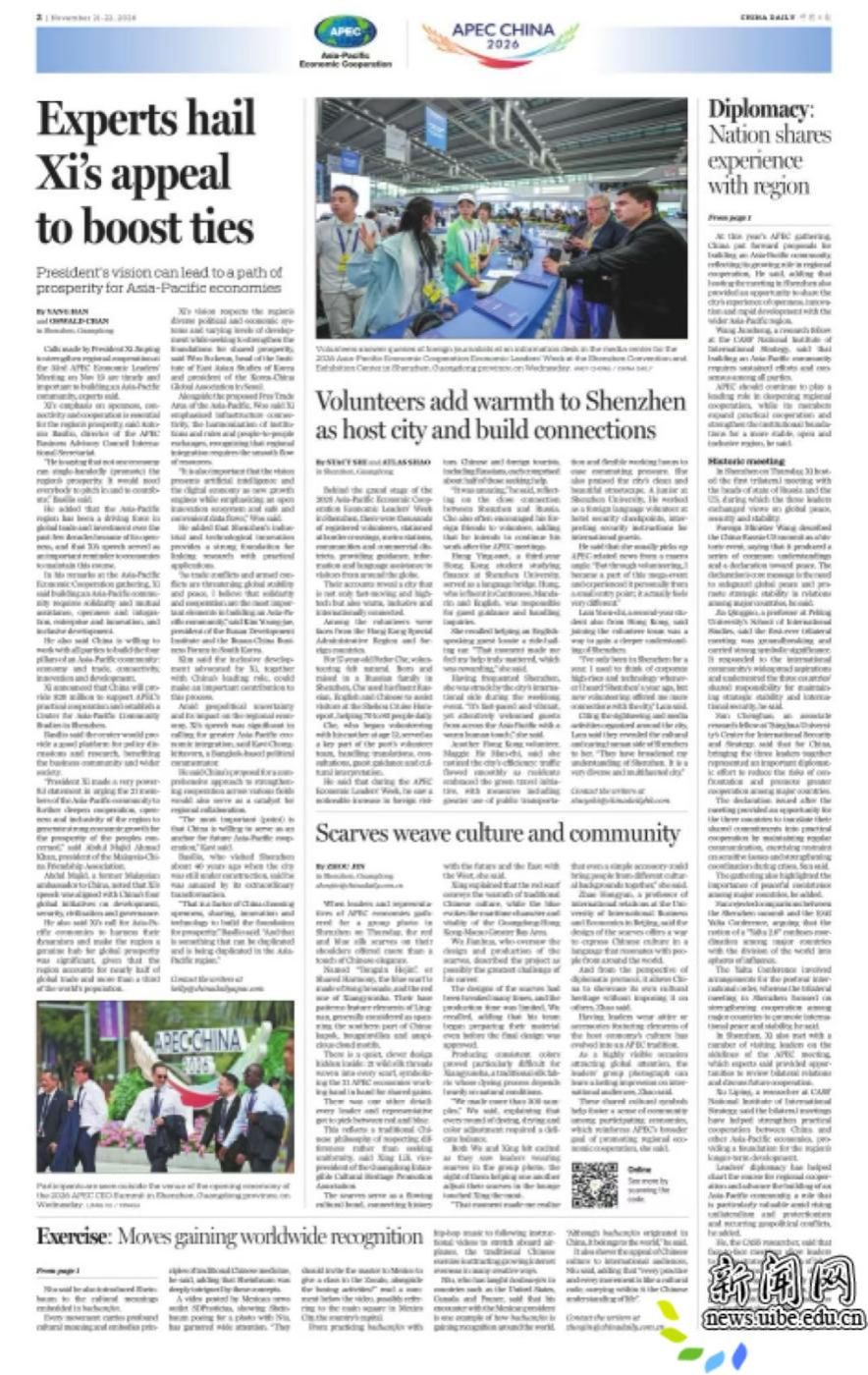
When leaders and representatives of APEC economies gathered for a group photo in Shenzhen on Thursday, the red and blue silk scarves on their shoulders offered more than a touch of Chinese elegance.
Named “Tongxin Hejin”, or Shared Harmony, the blue scarf is made of Song brocade, and the red one of Xiangyunsha. Their base patterns feature elements of Lingnan, generally considered as spanning the southern part of China: kapok, bougainvillea and auspicious cloud motifs.
There is a quiet, clever design hidden inside: 21 wild silk threads woven into every scarf, symbolizing the 21 APEC economies working hand in hand for shared gains.
There was one other detail: every leader and representative got to pick between red and blue.
This reflects a traditional Chinese philosophy of respecting differences rather than seeking uniformity, said Xing Lili, vice-president of the Guangdong Intangible Cultural Heritage Promotion Association.
The scarves serve as a flowing cultural bond, connecting history with the future and the East with the West, she said.
Xing explained that the red scarf conveys the warmth of traditional Chinese culture, while the blue evokes the maritime character and vitality of the Guangdong-Hong Kong-Macao Greater Bay Area.
Wu Jianhua, who oversaw the design and production of the scarves, described the project as possibly the greatest challenge of his career.
The designs of the scarves had been tweaked many times, and the production time was limited, Wu recalled, adding that his team began preparing their material even before the final design was approved.
Producing consistent colors proved particularly difficult for Xiangyunsha, a traditional silk fabric whose dyeing process depends heavily on natural conditions.
“We made more than 300 samples,” Wu said, explaining that every round of dyeing, drying and color adjustment required a delicate balance.
Both Wu and Xing felt excited as they saw leaders wearing scarves in the group photo; the sight of them helping one another adjust their scarves in the lounge touched Xing the most.
“That moment made me realize that even a simple accessory could bring people from different cultural backgrounds together,” she said.
Zhao Hongyan, a professor of international relations at the University of International Business and Economics in Beijing, said the design of the scarves offers a way to express Chinese culture in a language that resonates with people from around the world.
And from the perspective of diplomatic protocol, it allows China to showcase its own cultural heritage without imposing it on others, Zhao said.
Having leaders wear attire or accessories featuring elements of the host economy's culture has evolved into an APEC tradition.
As a highly visible occasion attracting global attention, the leaders' group photograph can leave a lasting impression on international audiences, Zhao said.
These shared cultural symbols help foster a sense of community among participating economies, which reinforces APEC's broader goal of promoting regional economic cooperation, she said.
(By ZHOU JIN in Shenzhen, Guangdong)
附原文链接:https://www.chinadaily.com.cn/a/202611/21/WS6b00e0efe4b03ebf8519dcb8.html